
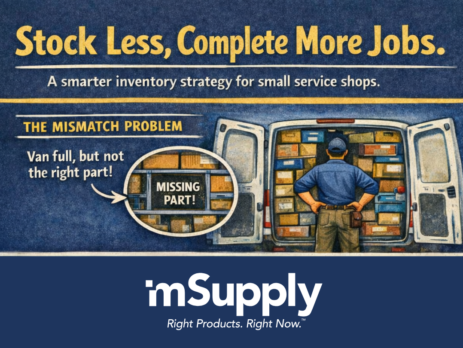
Most small service shops have an inventory problem.
To be clear, it’s not a shortage problem – one look at your storeroom tells you that. It’s a mismatch problem.
The van is full of parts, but your technician still can’t complete the job. That pattern costs more than the parts themselves. It costs the callback, the rescheduled appointment and the customer who doesn’t call back at all.
That’s why an inventory strategy for small service shops isn’t about stocking more.
It’s about stocking smarter.
Why Van Stock Decisions Go Wrong
The default approach is accumulation – and in theory, it makes sense. A technician gets burned on a stock-out, so that part goes on the van.
Then it happens again. And again. After a year, you’re carrying $8,000 in parts with a 40% turn rate, and you’re still missing the one component that kills your first-call completion.
The problem is that most shops build van stock from memory and reaction rather than job data. If you don’t know your top 20 most-needed parts by call type, you’re guessing. And guessing ties up cash while leaving gaps.
Your first-call completion rate is the metric that matters here. Shops that track it consistently find that a handful of part categories account for the majority of return trips. Identify those categories and you’ve found where your inventory strategy needs to change.
Set Stock Levels by Job Volume, Not Anxiety
The right van stock is a function of call volume, job mix and lead time from your supplier — not how nervous you feel about stock-outs.
Start with 90 days of closed job data. Pull the parts used most frequently across your top three call types.
For HVAC shops, that’s usually capacitors, contactors and a short list of motors.
For appliance repair, it tends to be water inlet valves, door switches and ignitors by brand mix.
For plumbing, you can expect valve seats, cartridges and fittings by the pipe sizes your market runs.
From that list, set a minimum stocking quantity based on weekly usage. If a part moves three times a week and your supplier delivers twice a week, carry eight units (not 30!).
The goal is coverage between restocking cycles, not a buffer against every possible scenario.
Build a Reorder Process You’ll Actually Use
Carrying the right parts only works if you replenish them before stock-outs happen. That means a reorder trigger, not a once-a-week eyeball check.
Here’s a simple system that you can easily implement: When any stocked part drops to half the minimum quantity, it automatically goes on the order. That threshold gives enough lead time to restock before you hit zero.
Review your parts list quarterly. Pull slow movers off the van and return or redistribute them. Add parts that appeared in missed-call reports more than twice in a quarter. Let the data drive the changes, not the last bad week.
Shops that run this process see two things happen quickly: 1) Inventory dollar value drops. 2) First-call completion rate goes up. Those two outcomes are directly connected, and both of them protect margin.
It turns out that stocking less of the right parts beats stocking more of the wrong ones every time.
